One thing that’s never changed in aviation is the fact that the profit margins for aircraft operators are wafer-thin, and the same was true for the Herc operations. Every possible effort had to be made to ensure that we reduced operating and maintenance costs without jeopardising the airworthiness of the aircraft.
With the assistance, of our team of engineers and technologists, several areas were identified where we could innovate to reduce costs without affecting the safety of the aircraft or operations.
One example had to do with engine turbine blade repairs. Safair was the first company to work in conjunction with a leading international blade building company to perform repairs to damaged blades and the cost savings were substantial.
Another example related to the retreading of tyres. We worked with the manufacturer to devise a system whereby we could continuously monitor the condition of tyres. In those days we used to aim to achieve 7 retreads per tyre which saved us approximately 60% compared to replacing the tyres with new ones.
Submit your own story
Please submit your own stories and images either by email to wkruger@safair.co.za or by uploading them using our online submissions tool. Click the appropriate option below.
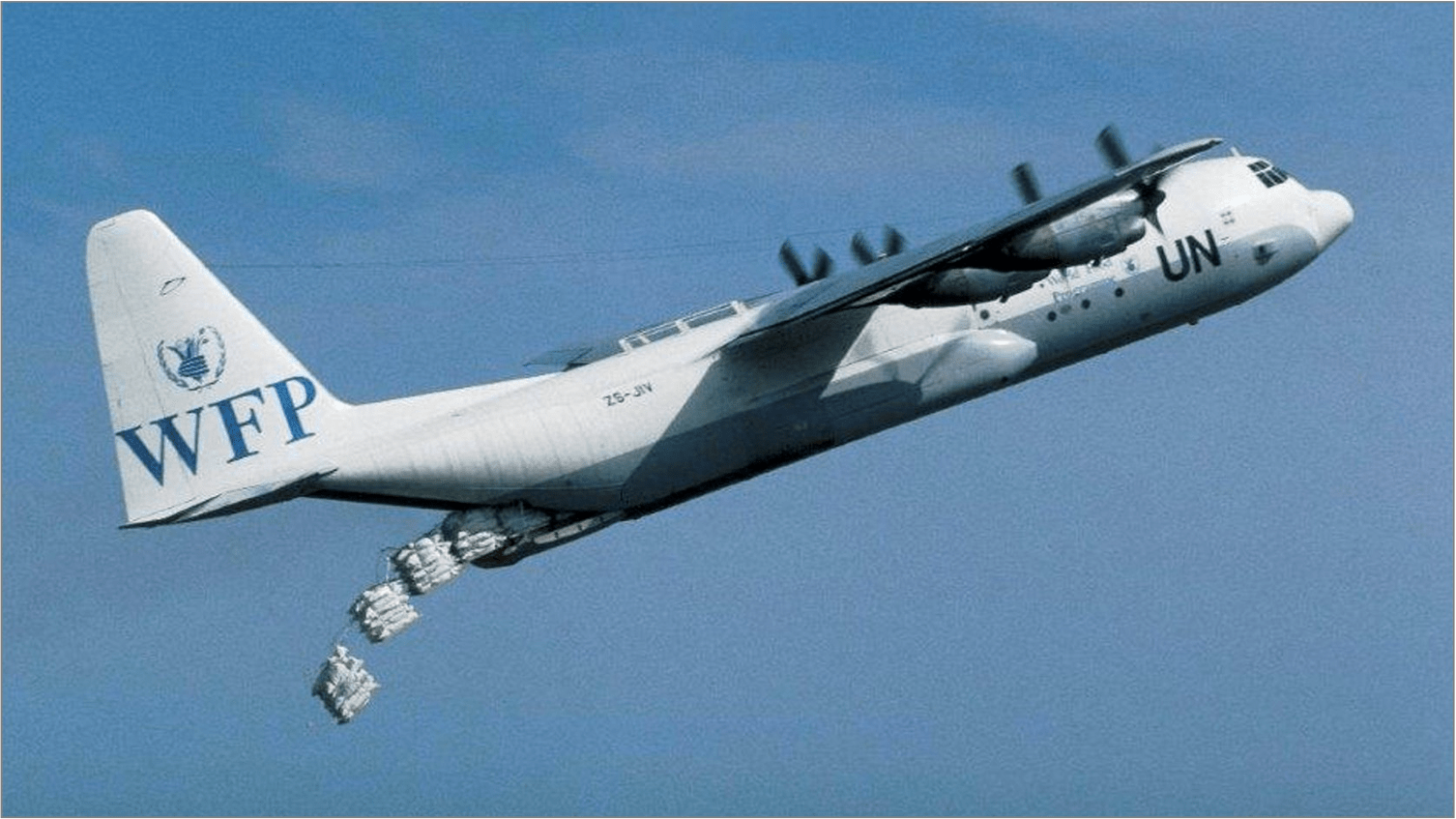
Safair has been involved in humanitarian aid and relief work for a long time and one of the tasks that we’ve often performed using the Hercs is food drops.
At one point we were operating these food delivery contracts on behalf of an international agency in support of people in food scarce regions on Africa.
In the beginning, the food was packed in 50kg bags and loaded onto freight pallets. We then used to drop these heavy pallets in designated zones that were a fair distance away from the cities and towns they were intended for, so that no damage would be caused to structures on the ground.
Unfortunately, the distance between the towns in need and the drop zones identified gave terrorist factions the opportunity to intercept the deliveries and steal the food before the agencies on the ground had the opportunity to load it up and transport it to the people who needed it. We had to find a way to safely perform the drops closer to the towns.
In the true Safair spirit, we tackled the issue head-on and designed an alternative system. We packed the food in smaller, lighter packages and loaded these packages onto lightweight honeycomb structures pallets. The benefit of this design was that the loads could be dropped over the cities and towns without the risk of hurting anyone on the ground or causing damage. The new pallets were also used by locals to build shelters.
Submit your own story
Please submit your own stories and images either by email to wkruger@safair.co.za or by uploading them using our online submissions tool. Click the appropriate option below.
In the mid 1970`s the Safair Board of Directors decided to expand the fleet of commercial
L382 series from eight to sixteen aircraft.
At that time the board had also chosen to modify 4 of the new aircraft such that they were able to perform dual roles as a passenger aircraft or freight aircraft, or a combination of the two. These aircraft were to replace the DC4 passenger aircraft which were operating a contract for the Witwatersrand Native Labour Association, known as Wenela, to transport Malawian workers to work on South African mines.
I was appointed as the Safair representative at the Lockheed Georgia company in Atlanta Georgia to manage the acceptance of 8 new Hercs and to oversee the conversion of the aforementioned aircraft from freighter to passenger configurations.
After an aircraft was manufactured, all systems had to be tested on the ground and thereafter a number of in-flight tests were carried out by the Lockheed test pilots. Each aircraft had to undergo a final test flight before an Acceptance Flight was done for the customer.
During the final test flight of aircraft number 16, a three-engine landing had to be performed because a flap drive dislodged on the right-hand flap resulting in a skew position of the flap, which obstructed the aileron’s capacity to move freely. The result was an emergency hard landing.
As the aircraft taxied back to the apron I noticed that the right-hand flap was hanging skew. I inquired as to the reason for it and insisted on a full report of the incident.
An in-depth investigation followed and it was found that the technician who was working on the flap drive was about to fit the last part in the system, a chain cotter pin securing the link on the two ends of the chain, when the lunch siren announced lunchtime. He immediately left everything and went on lunch. On return to the job he forgot to fit the cotter pin and signed the job off.
The vibration levels on propeller-driven aircraft is very high and during the test flights on this
particular aircraft the chain attachment link dislodged and the chain fell off the sprocket disconnecting the flap drive from the primary drive. The result was that the flap drive on the one side of the flap performed as designed, but the flap drive on the other side of the flap was disconnected and did not activate any movement of the flap on the other side. The flap extended askew and entered the aileron movement space blocking the aileron from moving freely in its space.
In the case of a 3 engine landing, the control surfaces require undisturbed maximum movement to safely control the aircraft.
It’s remarkable how one tiny lapse in concentration can have such a massive effect. It boggles the mind to consider the likelihood of similar incidents today with so many distractions, like mobile phones.
Submit your own story
Please submit your own stories and images either by email to wkruger@safair.co.za or by uploading them using our online submissions tool. Click the appropriate option below.
In the mid-1970s the Safair board had taken the decision to expand the fleet of commercial
L382 series from eight to sixteen aircraft. They had also decided to convert four of these new aircraft from freighters into passenger configurations.
At the time, I was working in the United States as the Safair representative taking acceptance of the new aircraft and project managing the conversions.
After acceptance of the new aircraft by Safair crews, 4 of the aircraft had to be flown to
New Braunsfield Airport near San Antonio Texas for conversion. The modifications were done by Ventura Company.
The modification basically comprised of cutting 3 holes into the side and above the floor level of the aircraft on each side of the airframe, and strengthening the airframe area surrounding each hole. These holes were to be escape hatches.
These modifications had to be approved by the USA Federal Aviation Authority before release. The modifications also included 101 passenger seats that were mounted on seven cargo pallets that operated on a roll-in-roll-off system. There was also an eighth pallet that was positioned on the ramp and served as a toilet cubicle. Inside all normal notices and alarms were fitted.
One of the FAA requirements was that the aircraft structure and sealing around each escape hatch had to withstand the pressure differential as applicable at maximum cruising altitude.
The first modified aircraft flew back to the Lockheed factory where it was pressurized up
in the presence of FAA, Lockheed, and Safair staff. After a lengthy period of pressurising the aircraft and almost getting to the required pressure differential the lunch siren blasted and the lady operating the pump immediately shut it down and left for lunch.
There was no non-return valve so the pressure simply decreased again. Despite requests from the audience that the process not be interrupted, the Lockheed management shrugged their shoulders and cited local Labour Laws.
After lunch, the process was resumed and after a number of hours the pressure differential was finally reached allowing the aircraft to pass the test.
When the first modified Herc arrived in South Africa, evacuation tests under the supervision of the South African Civil Aviation Authority, which in those days was designated as the DCA (Division of Civil Aviation), had to be conducted. Documentary compliance with all the US Federal Aviation Authority rules also had to be submitted and be proven.
Submit your own story
Please submit your own stories and images either by email to wkruger@safair.co.za or by uploading them using our online submissions tool. Click the appropriate option below.
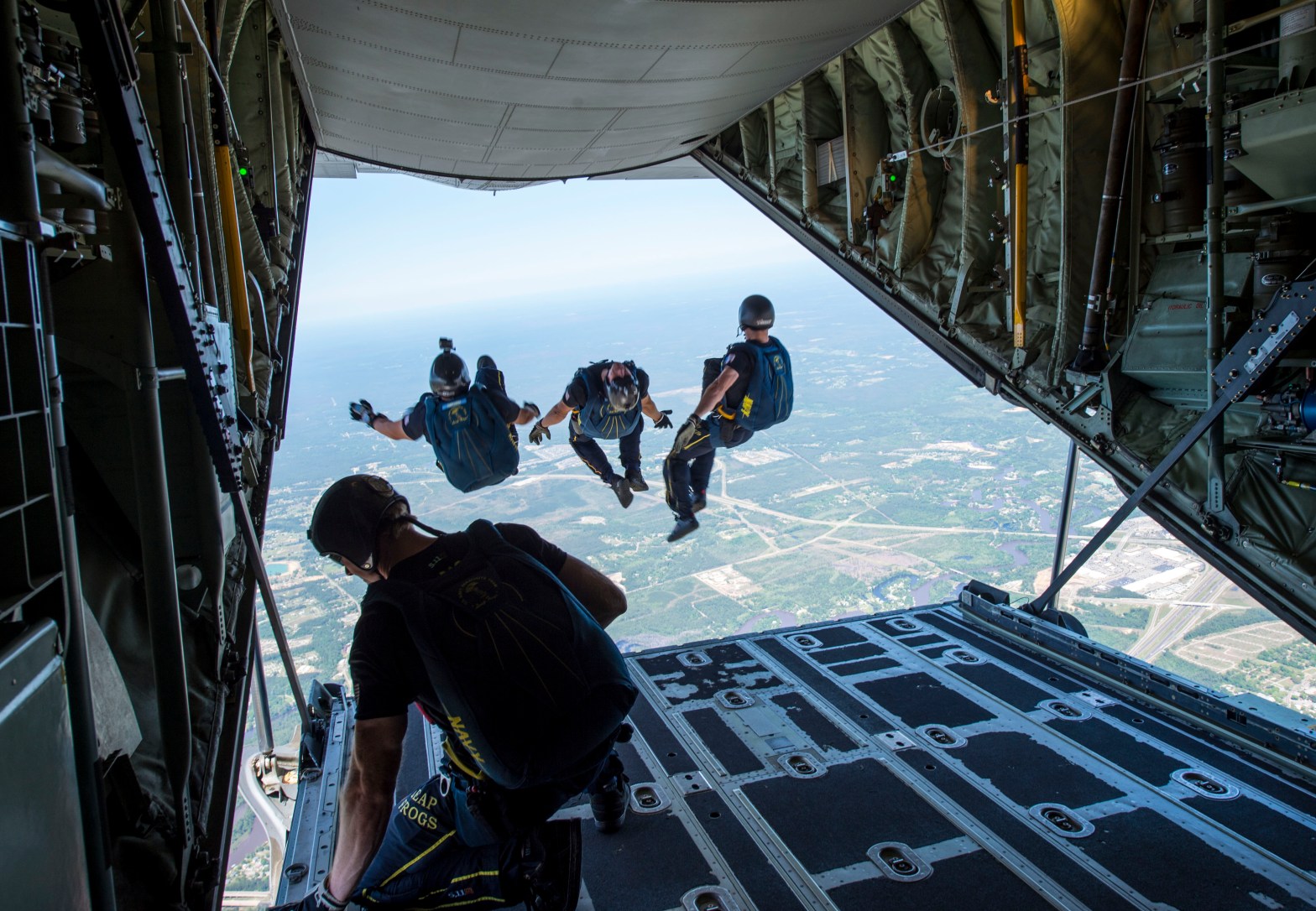
During the mid-1980s Safair was requested to provide two passenger Hercs to take part in the World Free Fall sky jumping competition in Quincy Illinois in the United States.
A detailed inspection by the US Federal Aviation Authority took place at the airport of entry into the USA to ensure compliance with all FAA rules. The aircraft passed the inspection with flying colours.
Each aircraft was loaded with 150 jumpers and additional D-rings had to be fitted to the floors of the aircraft to accommodate the extra parachutists.
A world record was set when 300 parachutists took part in the free-fall flights. Apparently, parachutists with a record of 100 jumps had to free-fall in the nude!
Submit your own story
Please submit your own stories and images either by email to wkruger@safair.co.za or by uploading them using our online submissions tool. Click the appropriate option below.
Safair has always been characterised by a “can do” approach to any problem and this was evident in the late 70s when we were contracted to carry fuel into Malawi. The country was experiencing a severe drought and the fuel was needed for the upcoming planting season.
We started off using 44-gallon drums to transport the fuel but the drums ended up getting damaged and leaking which caused a safety hazard. It was then decided that we should borrow some 1900 litre helicopter drop tanks from one of the government departments to transport the fuel but these proved very difficult to load and unload.
In the end, we decided to design and manufacture 7000-litre fuel tanks. Two such tanks could be carried per aircraft. These worked very well and were used for many years thereafter.
Submit your own story
Please submit your own stories and images either by email to wkruger@safair.co.za or by uploading them using our online submissions tool. Click the appropriate option below.

 Safair Herc Tales